


There are
n cities connected by some number of flights. You are given an array flights where flights[i] = [from<sub>i</sub>, to<sub>i</sub>, price<sub>i</sub>] indicates that there is a flight from city from<sub>i</sub> to city to<sub>i</sub> with cost price<sub>i</sub>.You are also given three integers
src, dst, and k, return the cheapest price from src to dst with at most k stops. If there is no such route, return-1.Example 1:
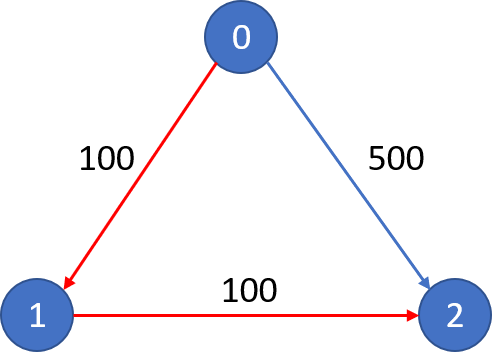
Input: n = 3, flights = [[0,1,100],[1,2,100],[0,2,500]], src = 0, dst = 2, k = 1
Output: 200
Explanation: The graph is shown.
The cheapest price from city0to city2with at most 1 stop costs 200, as marked red in the picture.
Example 2:
Input: n = 3, flights = [[0,1,100],[1,2,100],[0,2,500]], src = 0, dst = 2, k = 0
Output: 500
Explanation: The graph is shown.
The cheapest price from city0to city2with at most 0 stop costs 500, as marked blue in the picture.
Constraints:
1 <= n <= 100
0 <= flights.length <= (n * (n - 1) / 2)flights[i].length == 3
0 <= from<sub>i</sub>, to<sub>i</sub> < nfrom<sub>i</sub> != to<sub>i</sub>
1 <= price<sub>i</sub> <= 10<sup>4</sup>There will not be any multiple flights between two cities.
0 <= src, dst, k < n*
src != dst题目大意:
求只允许停k个站情况下,最便宜机票价格
解题思路:
BFS + Heap
这是单源最短路径的典型应用。可以用Dijkstra,机票价格相当于单源最短路径问题中的路径大小。一开始我用BFS,但得到TLE,因为存在循环,导致节点被重复访问(同一路径)。但一个节点的确可以被用不同路径访问。所以引入visited[node] = dis
解题步骤:
N/A
注意事项:
- node需要被多次访问,所以跟模板不同,visited的检测要放在neighbor循环之外且用node且初始化为空。visited不再是set,它需要记录node离src的距离。一方面用于循环检测,因为如果存在循环,会出现dist >= visited[node]。若该节点的当前距离小于之前的最小距离,此时也要加入到heap,因为贪婪法,虽然此路径费用较高,但它距离更近,当k限制比较小时,此路径可能满足要求。这就是为什么一个节点会被多次访问的原因。
- 若路径不存在返回-1
Python代码:
1 | def findCheapestPrice(self, n: int, flights: List[List[int]], src: int, dst: int, k: int) -> int: |
算法分析:
时间复杂度为O(VlogV),空间复杂度O(V)
算法II解题思路(推荐):
算法一比较难想,如果我们用BFS+Heap模板,我们用visited记录单点最贵price。但是此题由于有边数限制的最值问题,所以类似于DP,将限制条件引入作为参数或state。
visited[(node, distance)]=total_price
两处剪枝:
- 价格超过visited
- 路径长度超过k
其实法一也是用了两个剪枝条件,因为price低肯定是先出堆,所以只要比较某点最短路径visited即可,后出堆的点如果路径更长(价格肯定更高了),肯定可以剪枝。
Python代码:
1 | def findCheapestPrice(self, n: int, flights: List[List[int]], src: int, dst: int, k: int) -> int: |