


Given a
file and assume that you can only read the file using a given method read4, implement a method to read n characters.Method read4:
The API
read4 reads four consecutive characters from file, then writes those characters into the buffer array buf4.The return value is the number of actual characters read.
Note that
read4() has its own file pointer, much like FILE *fp in C.Definition of read4:
    Parameter:  char[] buf4
    Returns:    int

buf4[] is a destination, not a source. The results from read4 will be copied to buf4[].
Below is a high-level example of how
read4 works: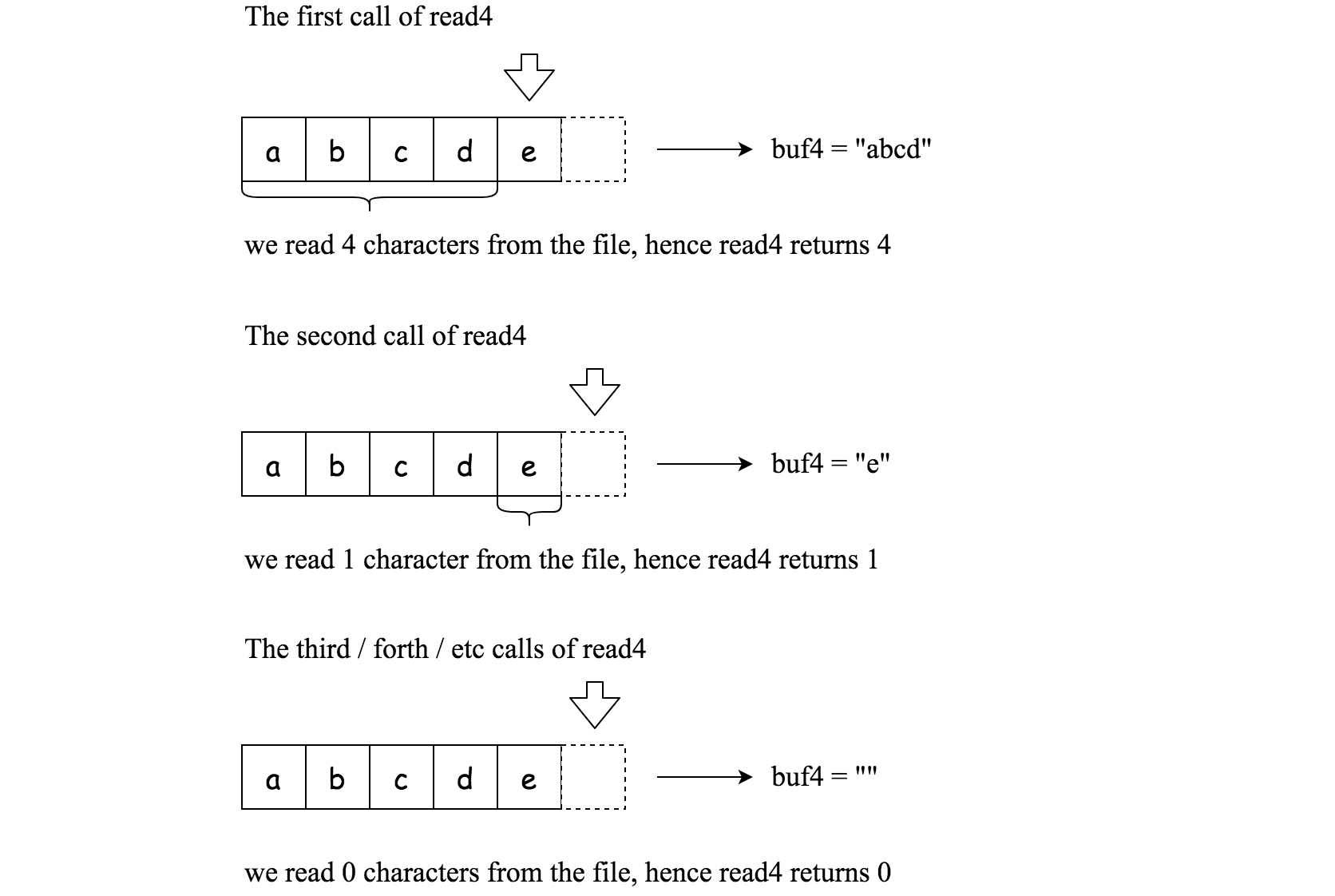
File file(“abcde"); // File is "abcde", initially file pointer (fp) points to 'a'
char[] buf4 = new char[4]; // Create buffer with enough space to store characters
read4(buf4); // read4 returns 4\. Now buf4 = "abcd", fp points to 'e'
read4(buf4); // read4 returns 1\. Now buf4 = "e", fp points to end of file
read4(buf4); // read4 returns 0\. Now buf4 = "", fp points to end of file
Method read:
By using the
read4 method, implement the method read that reads n characters from file and store it in the buffer array buf. Consider that you cannot manipulate file directly.The return value is the number of actual characters read.
Definition of read:
    Parameters:    char[] buf, int n
    Returns:    int

buf[] is a destination, not a source. You will need to write the results to buf[].
Note:
Consider that you cannot manipulate the file directly. The file is only accessible for
read4 but not for read.
The read function will only be called once for each test case.You may assume the destination buffer array,
buf, is guaranteed to have enough space for storing n characters.Example 1:
Input: file = “abc”, n = 4
Output: 3
Explanation: After calling your read method, buf should contain “abc”. We read a total of 3 characters from the file, so return 3.
Note that “abc” is the file’s content, not buf. buf is the destination buffer that you will have to write the results to.
Example 2:
Input: file = “abcde”, n = 5
Output: 5
Explanation: After calling your read method, buf should contain “abcde”. We read a total of 5 characters from the file, so return 5.
Example 3:
Input: file = “abcdABCD1234”, n = 12
Output: 12
Explanation: After calling your read method, buf should contain “abcdABCD1234”. We read a total of 12 characters from the file, so return 12.
Constraints:
1 <= file.length <= 500file consist of English letters and digits.
1 <= n <= 1000题目大意:
Karat题,有一个函数read4,如此调用
1 | buf4 = [' '] * 4 |
buf4是填充后的结果,是一个大小为4的char list
count是buf4的有数据的实际大小(4或更小,取决于是否文件最后一段是否不够4)
现在要实现这个函数1
def read(self, buf, n)
buf是字符列表,n是想要读取文件的大小,返回值为n或者更小,取决于是否文件大小是否小于n
解题思路:
N/A
解题步骤:
N/A
注意事项:
- 若count为0,跳出循环
Python代码:
1 | def read(self, buf, n): |
算法分析:
时间复杂度为O(n),空间复杂度O(1)