


You are given a nested list of integers
nestedList. Each element is either an integer or a list whose elements may also be integers or other lists.The depth of an integer is the number of lists that it is inside of. For example, the nested list
[1,[2,2],[[3],2],1] has each integer’s value set to its depth.Return the sum of each integer in
nestedList multiplied by its depth.Example 1:
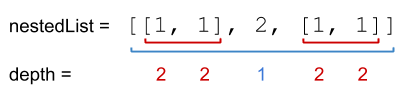
Input: nestedList = [[1,1],2,[1,1]]
Output: 10
Explanation: Four 1’s at depth 2, one 2 at depth 1. 12 + 12 + 21 + 12 + 12 = 10.
Example 2:
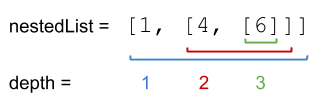
Input: nestedList = [1,[4,[6]]]
Output: 27
Explanation: One 1 at depth 1, one 4 at depth 2, and one 6 at depth 3. 11 + 42 + 63 = 27.
Example 3:
Input: nestedList = [0]
Output: 0
Constraints:
1 <= nestedList.length <= 50
The values of the integers in the nested list is in the range [-100, 100].The maximum *depth of any integer is less than or equal to
50.题目大意:
求NestedInteger的和。越深,权重越高
最后计算权重解题思路(推荐):
BFS按层遍历
Nested List题目:
LeetCode 341 Flatten Nested List Iterator Iterator - Stack
LeetCode 339 Nested List Weight Sum - BFS
LeetCode 364 Nested List Weight Sum II - BFS
解题步骤:
N/A
注意事项:
- Line 9中,需要将NestedInteger展开,里面的所有的NestedInteger入列。Python中,用extend来加入list中所有元素到另一个list,而不是append
- 按层遍历模板中,不需要level变量,for可以达到。
Python代码:
1 | def depthSum(self, nestedList) -> int: |
算法分析:
时间复杂度为O(n),空间复杂度O(k), k为每层最多节点数 + 最大层数
每层计算权重算法II解题思路:
Python代码:
1 | def depthSum(self, nestedList) -> int: |
算法分析:
时间复杂度为O(n),空间复杂度O(k)