


Given an array of integers
heights representing the histogram’s bar height where the width of each bar is 1, return the area of the largest rectangle in the histogram.Example 1:
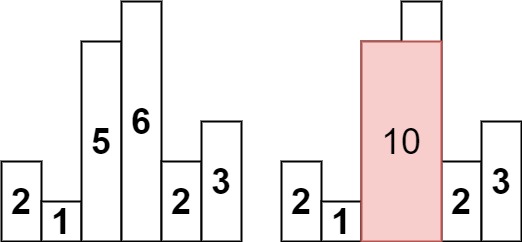
Input: heights = [2,1,5,6,2,3]
Output: 10
Explanation: The above is a histogram where width of each bar is 1.
The largest rectangle is shown in the red area, which has an area = 10 units.
Example 2:
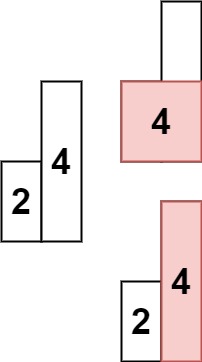
Input: heights = [2,4]
Output: 4
Constraints:
1 <= heights.length <= 10<sup>5</sup>
0 <= heights[i] <= 10<sup>4</sup>题目大意:
求直方图中最大的矩形面积
解题思路:
类似于L042 Trapping Rain Water的stack法,但此题水量是反的。所以仍然用Stack,但用递增栈
解题步骤:
N/A
注意事项:
- 比L042稍简单,不用处理最后一个bar高度和宽度计算,但是用递增栈且公式中宽度计算仍然采用i - stack[-1] - 1,因为bar并不一定连续,如212, 最后一个2入栈,栈中剩下[_, 1]第一个2已经出栈了,但是可以有水量的。
- 原数组头尾加入0,头0是因为公式有stack[-1]避免越界, 尾0是因为让所有留在栈中的bar出栈且计算。
大厦题,首尾加入节点:
LeetCode 084 Largest Rectangle in Histogram
LeetCode 218 The Skyline Problem
Python代码:
1 | def largestRectangleArea(self, heights: List[int]) -> int: |
算法分析:
时间复杂度为O(n),空间复杂度O(n)