


You are given the
root of a binary tree containing digits from 0 to 9 only.Each root-to-leaf path in the tree represents a number.
For example, the root-to-leaf path
1 -> 2 -> 3 represents the number 123.Return the total sum of all root-to-leaf numbers. Test cases are generated so that the answer will fit in a 32-bit integer.
A leaf node is a node with no children.
Example 1:
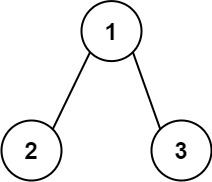
Input: root = [1,2,3]
Output: 25
Explanation:
The root-to-leaf path1->2represents the number12.
The root-to-leaf path1->3represents the number13.
Therefore, sum = 12 + 13 =25.
Example 2:
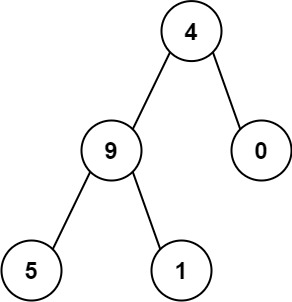
Input: root = [4,9,0,5,1]
Output: 1026
Explanation:
The root-to-leaf path4->9->5represents the number 495.
The root-to-leaf path4->9->1represents the number 491.
The root-to-leaf path4->0represents the number 40.
Therefore, sum = 495 + 491 + 40 =1026.
Constraints: The number of nodes in the tree is in the range
[1, 1000].0 <= Node.val <= 9
The depth of the tree will not exceed 10.题目大意:
由root到叶子节点的数字组成多位数的数,求这些数的总和
解题思路:
题目提到叶子节点,所以DFS中要含叶子节点的情况
解题步骤:
N/A
注意事项:
- 题目提到叶子节点,所以DFS中要含叶子节点的情况。当然还要有root为空的情况,这样root.left和root.right不用非空检查,代码更简洁
Python代码:
1 | def sumNumbers(self, root: TreeNode) -> int: |
算法分析:
时间复杂度为O(n),空间复杂度O(1)