


There is a one-dimensional garden on the x-axis. The garden starts at the point
0 and ends at the point n. (i.e The length of the garden is n).There are
n + 1 taps located at points [0, 1, ..., n] in the garden.Given an integer
n and an integer array ranges of length n + 1 where ranges[i] (0-indexed) means the i-th tap can water the area [i - ranges[i], i + ranges[i]] if it was open.Return the minimum number of taps that should be open to water the whole garden, If the garden cannot be watered return -1.
Example 1:
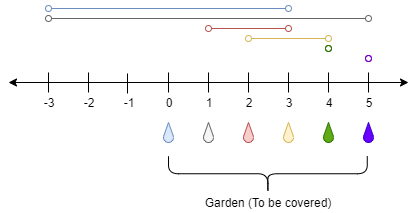
Input: n = 5, ranges = [3,4,1,1,0,0]
Output: 1
Explanation: The tap at point 0 can cover the interval [-3,3]
The tap at point 1 can cover the interval [-3,5]
The tap at point 2 can cover the interval [1,3]
The tap at point 3 can cover the interval [2,4]
The tap at point 4 can cover the interval [4,4]
The tap at point 5 can cover the interval [5,5]
Opening Only the second tap will water the whole garden [0,5]
Example 2:
Input: n = 3, ranges = [0,0,0,0]
Output: -1
Explanation: Even if you activate all the four taps you cannot water the whole garden.
Example 3:
Input: n = 7, ranges = [1,2,1,0,2,1,0,1]
Output: 3
Example 4:
Input: n = 8, ranges = [4,0,0,0,0,0,0,0,4]
Output: 2
Example 5:
Input: n = 8, ranges = [4,0,0,0,4,0,0,0,4]
Output: 1
Constraints:
1 <= n <= 10<sup>4</sup>
ranges.length == n + 1*
0 <= ranges[i] <= 100题目大意:
用多少个水龙头覆盖整个花园
解题思路:
两个难点,此题类似于jump game,这一层某个水龙头浇到最远点的水龙头也就是这一层的水龙头,这是难点一。
难点二是跟jump game不同,这题可以往前跳,也就是如例子中,点2表示从1跳到3,因为它的范围是1. 所以要重新计算每个水龙头的起点=它的左半范围起点
解题步骤:
N/A
注意事项:
- 第一步转化成jump game,jump game每个数值都是长度。若左半范围起点小于等于0,所有这些水龙头归结到起点0,长度为i + ranges[i], 其余情况是ranges[i] * 2
- 完全用jump game的程序
Python代码:
1 | def minTaps(self, n: int, ranges: List[int]) -> int: |
算法分析:
时间复杂度为O(n),空间复杂度O(n)