
Given a reference of a node in a connected undirected graph.
Return a deep copy (clone) of the graph.
Each node in the graph contains a val (int) and a list (List[Node]) of its neighbors.
<pre>class Node { public int val; public List<Node> neighbors; } </pre>
Test case format:
For simplicity sake, each node's value is the same as the node's index (1-indexed). For example, the first node with val = 1, the second node with val = 2, and so on. The graph is represented in the test case using an adjacency list.
Adjacency list is a collection of unordered lists used to represent a finite graph. Each list describes the set of neighbors of a node in the graph.
The given node will always be the first node with val = 1. You must return the copy of the given node as a reference to the cloned graph.
Example 1:
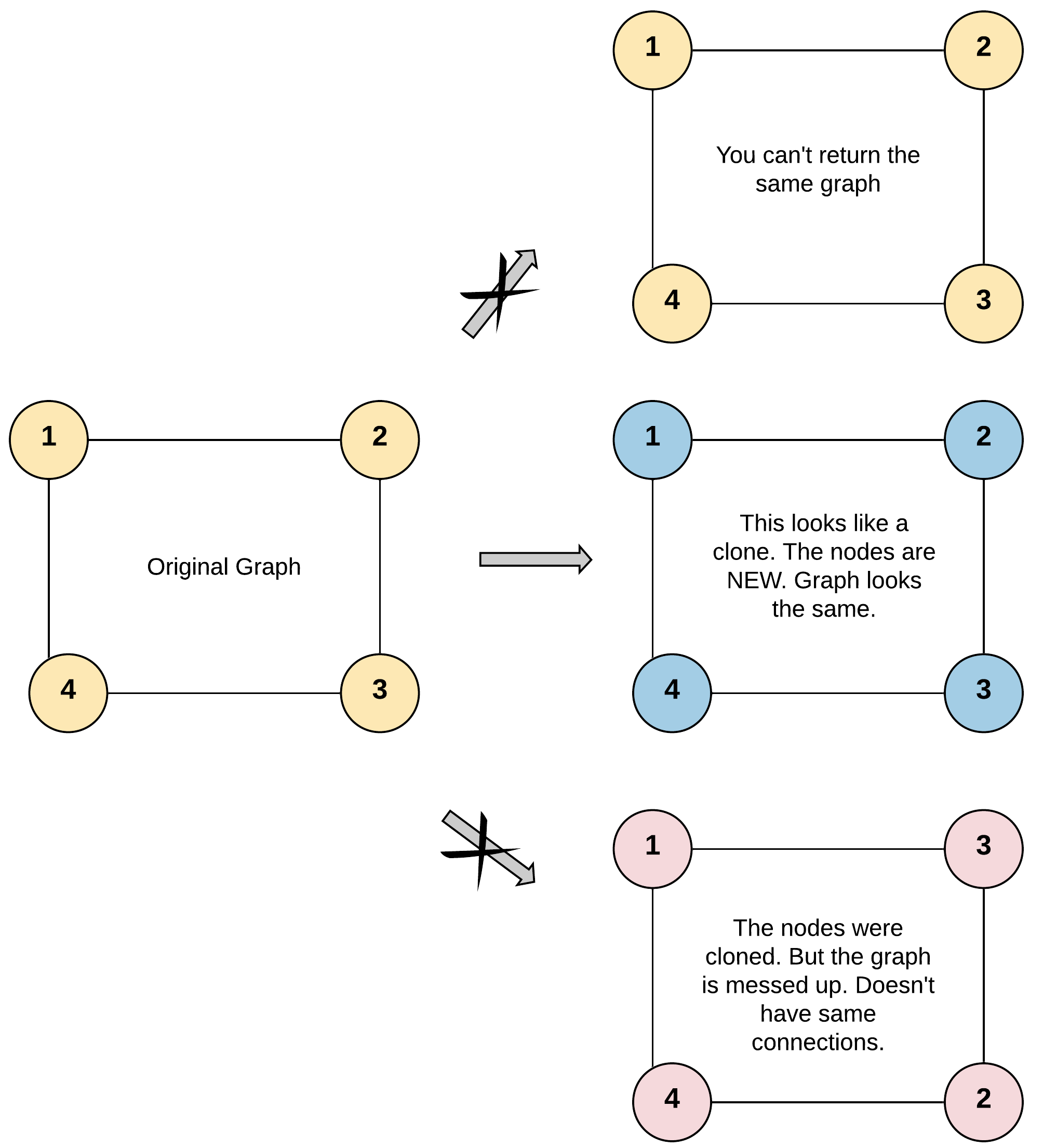
<pre>Input: adjList = [[2,4],[1,3],[2,4],[1,3]] Output: [[2,4],[1,3],[2,4],[1,3]] Explanation: There are 4 nodes in the graph. 1st node (val = 1)'s neighbors are 2nd node (val = 2) and 4th node (val = 4). 2nd node (val = 2)'s neighbors are 1st node (val = 1) and 3rd node (val = 3). 3rd node (val = 3)'s neighbors are 2nd node (val = 2) and 4th node (val = 4). 4th node (val = 4)'s neighbors are 1st node (val = 1) and 3rd node (val = 3). </pre>
Example 2:

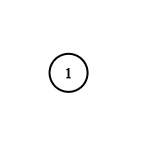
<pre>Input: adjList = [[]] Output: [[]] Explanation: Note that the input contains one empty list. The graph consists of only one node with val = 1 and it does not have any neighbors. </pre>
Example 3:
<pre>Input: adjList = [] Output: [] Explanation: This an empty graph, it does not have any nodes. </pre>
Example 4:

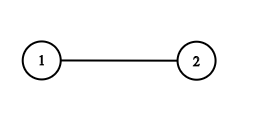
<pre>Input: adjList = [[2],[1]] Output: [[2],[1]] </pre>
Constraints:
1 <= Node.val <= 100Node.valis unique for each node.- Number of Nodes will not exceed 100.
- There is no repeated edges and no self-loops in the graph.
- The Graph is connected and all nodes can be visited starting from the given node.

</div>
</div>
题目大意:
深度复制图。注意要复制所有邻接节点。
算法I解题思路(推荐):
三步走。分开写逻辑会显得清晰点。
- BFS搜索所有节点,变成
邻接表节点列表。 - 复制节点。旧新节点映射存在dict中
- 根据node.neighbors复制边。
注意事项:
- 空节点判断Line 2-3
- BFS访问是收集节点列表,并不是变成邻接表。如果是含循环的图,由于用了visited,所以邻接表只能复制一半的边,不能用邻接表
Python代码:
1
2
3
4
5
6
7
8
9
10
11
12
13
14
15
16
17
18
19
20
21
22
23
24
25
26
27
28def cloneGraph(self, node: 'Node') -> 'Node':
if not node:
return None
di = {}
node_list = self.bfs(node)
for n in node_list:
di[n] = Node(n.val)
for n in node_list:
for n2 in n.neighbors:
di[n].neighbors.append(di[n2])
return di[node]
def bfs(self, input):
queue = deque([input])
visited = {input}
# graph = collections.defaultdict(list)
res = []
while queue:
node = queue.popleft()
# graph[node] = []
res.append(node)
for neighbor in node.neighbors:
if neighbor in visited:
continue
queue.append(neighbor)
visited.add(neighbor)
# graph[node].append(neighbor)
return res
Java代码:
1
2
3
4
5
6
7
8
9
10
11
12
13
14
15
16
17
18
19
20
21
22
23
24
25
26
27
28
29
30
31
32
33
34
35
36
37// another bfs3 method uses 3 steps, convert graph to adjacent list by bfs (flatten the graph),
//clone vertices, clone edges
public void bfs3(UndirectedGraphNode node, HashMap<UndirectedGraphNode, UndirectedGraphNode> map) {
ArrayList<UndirectedGraphNode> nodes = getNodes(node);
// Copy vertices
for(UndirectedGraphNode old : nodes) {
UndirectedGraphNode newNode = new UndirectedGraphNode(old.label);
map.put(old, newNode);
}
// Copy edges
for(UndirectedGraphNode old : nodes) {
for(UndirectedGraphNode neighbor : old.neighbors) {
map.get(old).neighbors.add(map.get(neighbor));
}
}
}
public ArrayList<UndirectedGraphNode> getNodes(UndirectedGraphNode node) {
Queue<UndirectedGraphNode> q = new LinkedList<>();
Set<UndirectedGraphNode> result = new HashSet<>();
q.offer(node);
result.add(node); // Use result set so we can save the visited set
while(!q.isEmpty()) {
UndirectedGraphNode n = q.poll();
for(UndirectedGraphNode neighbor : n.neighbors) {
if(result.contains(neighbor))
continue;
q.offer(neighbor);
result.add(neighbor);
}
}
ArrayList<UndirectedGraphNode> reList = new ArrayList<UndirectedGraphNode>();
reList.addAll(result);
return reList;
}
算法II解题思路:
不分开三步写
Java代码:
1
2
3
4
5
6
7
8
9
10
11
12
13
14
15
16
17
18
19
20
21
22
23
24
25
26public UndirectedGraphNode cloneGraph2(UndirectedGraphNode node) {
if(node == null)
return null;
HashMap<UndirectedGraphNode, UndirectedGraphNode> map = new HashMap<>();
bfs(node, map);
return map.get(node);
}
public void bfs(UndirectedGraphNode node, HashMap<UndirectedGraphNode, UndirectedGraphNode> map) {
Queue<UndirectedGraphNode> q = new LinkedList<>();
q.offer(node);
map.put(node, new UndirectedGraphNode(node.label));
while(!q.isEmpty()) {
UndirectedGraphNode head = q.poll();
for(UndirectedGraphNode neighbor : head.neighbors) {
if(!map.containsKey(neighbor)) {
q.offer(neighbor);
// Clone children's vertex
map.put(neighbor, new UndirectedGraphNode(neighbor.label));
}
// Clone edge
map.get(head).neighbors.add(map.get(neighbor));
}
}
}
算法II解题思路:
DFS。
1
2
3
4
5
6
7
8
9
10
11
12
13
14
15
16
17
18
19public UndirectedGraphNode cloneGraph(UndirectedGraphNode node) {
HashMap<Integer, UndirectedGraphNode> map = new HashMap<Integer, UndirectedGraphNode>();
return cloneGraphR(node, map);
}
public UndirectedGraphNode cloneGraphR(UndirectedGraphNode node,
HashMap<Integer, UndirectedGraphNode> map) {
if (node == null)
return node;
if (map.containsKey(node.label))
return map.get(node.label);
UndirectedGraphNode result = new UndirectedGraphNode(node.label);
map.put(node.label, result);
for (UndirectedGraphNode child : node.neighbors) {
result.neighbors.add(cloneGraphR(child, map));
}
return result;
}
算法分析:
时间复杂度为O(# of results),空间复杂度O(lengh(high))。