
KK's blog

每天积累多一些

0%

LeetCode


You are given two integers, x and y, which represent your current location on a Cartesian grid: (x, y). You are also given an array points where each points[i] = [a<sub>i</sub>, b<sub>i</sub>] represents that a point exists at (a<sub>i</sub>, b<sub>i</sub>). A point is valid if it shares the same x-coordinate or the same y-coordinate as your location.

Return the index (0-indexed) of the valid point with the smallest Manhattan distance from your current location. If there are multiple, return the valid point with the smallest index. If there are no valid points, return -1.

The Manhattan distance between two points (x<sub>1</sub>, y<sub>1</sub>) and (x<sub>2</sub>, y<sub>2</sub>) is abs(x<sub>1</sub> - x<sub>2</sub>) + abs(y<sub>1</sub> - y<sub>2</sub>).

Example 1:

Input: x = 3, y = 4, points = [[1,2],[3,1],[2,4],[2,3],[4,4]]
Output: 2
Explanation: Of all the points, only [3,1], [2,4] and [4,4] are valid. Of the valid points, [2,4] and [4,4] have the smallest Manhattan distance from your current location, with a distance of 1. [2,4] has the smallest index, so return 2.


Example 2:

Input: x = 3, y = 4, points = [[3,4]]
Output: 0
Explanation: The answer is allowed to be on the same location as your current location.


Example 3:

Input: x = 3, y = 4, points = [[2,3]]
Output: -1
Explanation: There are no valid points.


Constraints:

1 <= points.length <= 10<sup>4</sup> points[i].length == 2
* 1 <= x, y, a<sub>i</sub>, b<sub>i</sub> <= 10<sup>4</sup>

题目大意:

给定一个坐标和一堆坐标,这个坐标与某个点在同一条y轴或x轴上叫合法点,求它到这些点的最小曼哈顿距离对应的点的下标,若有多个结果,返回最小的数组下标。

解题思路:

Easy题,根据题意求

解题步骤:

N/A

注意事项:

  1. Python代码:

    1
    2
    3
    4
    5
    6
    7
    8
    9
    10
    11
    def nearestValidPoint(self, x: int, y: int, points: List[List[int]]) -> int:
    min_dis = float('inf')
    res = -1
    for i, (_x, _y) in enumerate(points):
    if x == _x or y == _y:
    if abs(x - _x) + abs(y - _y) < min_dis:
    min_dis = abs(x - _x) + abs(y - _y)
    res = i
    elif abs(x - _x) + abs(y - _y) == min_dis and i < res:
    res = i
    return res

算法分析:

时间复杂度为O(n),空间复杂度O(1)
LeetCode


You are given an undirected graph. You are given an integer n which is the number of nodes in the graph and an array edges, where each edges[i] = [u<sub>i</sub>, v<sub>i</sub>] indicates that there is an undirected edge between u<sub>i</sub> and v<sub>i</sub>.

A connected trio is a set of three nodes where there is an edge between every pair of them.

The degree of a connected trio is the number of edges where one endpoint is in the trio, and the other is not.

Return the minimum degree of a connected trio in the graph, or -1 if the graph has no connected trios.

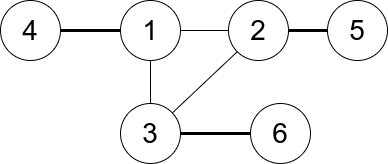
Example 1:


Input: n = 6, edges = [[1,2],[1,3],[3,2],[4,1],[5,2],[3,6]]
Output: 3
Explanation: There is exactly one trio, which is [1,2,3]. The edges that form its degree are bolded in the figure above.


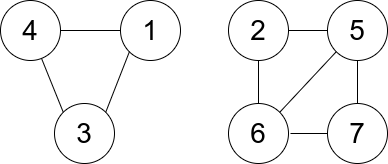
Example 2:


Input: n = 7, edges = [[1,3],[4,1],[4,3],[2,5],[5,6],[6,7],[7,5],[2,6]]
Output: 0
Explanation: There are exactly three trios:
1) [1,4,3] with degree 0.
2) [2,5,6] with degree 2.
3) [5,6,7] with degree 2.


Constraints:

2 <= n <= 400 edges[i].length == 2
`1 <= edges.length <= n (n-1) / 2*1 <= ui, vi <= n*ui != vi`
* There are no repeated edges.

题目大意:

给定一个图,trio是三个节点直接互相相连,而度数表示连着trio的边的个数

解题思路:

根据定义,找出所有三个节点的组合,判断是否trio,然后根据trio的每个节点的度数总和 - 6即为所求
遍历所有三个节点组合时,会重复了两次。所以一个优化是,先按度数排序节点,若节点度数大于等于最小度数除以3,跳出循环。因为这个最小度数的节点已经大于等于3,trio里其他两个度数比它大的节点的度数更加会大于最小度数除以3,这样总度数肯定大于此时的最小度数

解题步骤:

N/A

注意事项:

  1. 根据定义,找出所有三个节点的组合u -> v, v -> w, w是否在u中,判断是否trio。先按度数排序节点,若节点度数大于等于最小度数除以3,跳出循环
  2. 邻接图用set,因为Line 13查找w是否在u中可以提高效率
  3. min_degree / 3不是// 3

Python代码:

1
2
3
4
5
6
7
8
9
10
11
12
13
14
15
def minTrioDegree(self, n: int, edges: List[List[int]]) -> int:
graph = collections.defaultdict(set) # use set coz if w in graph[u]
for u, v in edges:
graph[u].add(v)
graph[v].add(u)

min_degree = float('inf')
for u in sorted(range(1, n + 1), key=lambda x: len(graph[x])):
if len(graph[u]) >= min_degree / 3: # remember / 3 not // 3
break
for v in graph[u]:
for w in graph[v]:
if w in graph[u]:
min_degree = min(min_degree, len(graph[u]) + len(graph[v]) + len(graph[w]))
return min_degree - 6 if min_degree != float('inf') else -1

算法分析:

时间复杂度为O(n3),空间复杂度O(n2)

LeetCode


You are given the root of a binary tree with n nodes where each node in the tree has node.val coins. There are n coins in total throughout the whole tree.

In one move, we may choose two adjacent nodes and move one coin from one node to another. A move may be from parent to child, or from child to parent.

Return the minimum number of moves required to make every node have exactly one coin.

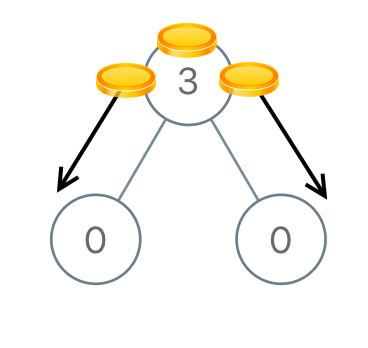
Example 1:


Input: root = [3,0,0]
Output: 2
Explanation: From the root of the tree, we move one coin to its left child, and one coin to its right child.


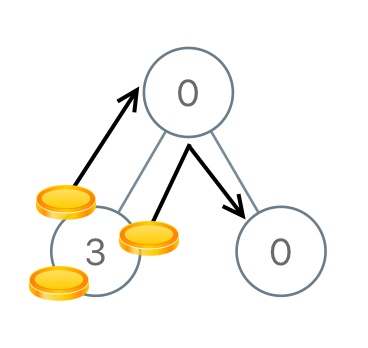
Example 2:


Input: root = [0,3,0]
Output: 3
Explanation: From the left child of the root, we move two coins to the root [taking two moves]. Then, we move one coin from the root of the tree to the right child.


Constraints:

The number of nodes in the tree is n. 1 <= n <= 100
0 <= Node.val <= n The sum of all Node.val is n.

题目大意:

二叉树某些节点含有硬币,求将这些硬币推向其他节点,使得所有节点都有一个硬币,求总移动次数

解题思路:

先思考,若硬币都在root,也就是求所有节点的路径和。可以用每个节点的路径和求和,也可以定义dfs返回节点数,用全局变量加左右数,每轮递归都加一次,所以每个节点被加了其路径长度的次数。本算法采用后者
下面思考若硬币不在root,由于硬币可以从儿子给父亲,这是双向的,所以dfs定义为儿子给父亲的硬币数,若节点没有硬币,返回值会是负数,也就是父亲给儿子硬币,此时这个负数正是以此节点为root的数的总的节点数,所以与上述定义一致。
所以返回root.val + left + right - 1,left和right都是负数,left + right - 1是树的大小的负数,此结果为剩余硬币推给父亲的硬币数
res += abs(left) + abs(right)左子树和右子树所有节点一起走一条边的路径和

解题步骤:

N/A

注意事项:

  1. dfs定义为儿子给父亲的硬币数(若有硬币),同时是子树的节点数的负数(若无硬币)

Python代码:

1
2
3
4
5
6
7
8
9
10
11
12
13
14
def distributeCoins(self, root: TreeNode) -> int:
res = 0

def dfs(root):
if not root:
return 0
nonlocal res
left = dfs(root.left)
right = dfs(root.right)
res += abs(left) + abs(right)
return root.val + left + right - 1

dfs(root)
return res

算法分析:

时间复杂度为O(n),空间复杂度O(1)
A nonogram is a logic puzzle, similar to a crossword, in which the player is given
a blank grid and has to color it according to some instructions. Specifically,
each cell can be either black or white, which we will represent as 0 for black and
1 for white.
+————+
| 1 1 1 1 |
| 0 1 1 1 |
| 0 1 0 0 |
| 1 1 0 1 |
| 0 0 1 1 |
+————+
For each row and column, the instructions give the lengths of contiguous runs of
black (0) cells. For example, the instructions for one row of [ 2, 1 ] indicate
that there must be a run of two black cells, followed later by another run of one
black cell, and the rest of the row filled with white cells.
These are valid solutions: [ 1, 0, 0, 1, 0 ] and [ 0, 0, 1, 1, 0 ] and also [ 0,
0, 1, 0, 1 ]
This is not valid: [ 1, 0, 1, 0, 0 ] since the runs are not in the correct order.
This is not valid: [ 1, 0, 0, 0, 1 ] since the two runs of 0s are not separated by
1s.
Your job is to write a function to validate a possible solution against a set of
instructions. Given a 2D matrix representing a player’s solution; and instructions
for each row along with additional instructions for each column; return True or
False according to whether both sets of instructions match.

题目大意:

Nonogram日本游戏,0表示黑子,[2, 1]表示黑子的连续数目,如棋盘状态[ 1, 0, 0, 1, 0 ],表示连续黑子数为[2, 1]
[ 1, 0, 0, 0, 1 ]连续黑子数为[3]. 验证棋盘的每一行和每一列是否满足rows和cols所指定的连续黑子数

解题思路:

按题意求解

解题步骤:

N/A

注意事项:

  1. 递归只有一种情况
  2. 答案需求全局

Python代码:

1
2
3
4
5
6
7
8
9
10
11
12
13
14
15
16
17
18
19
20
21
22
23
24
25
def valid_nonogram(self, matrix, rows, cols):
for i in range(len(matrix)):
if self.get_consecutive_zeros(matrix[i]) != rows[i]:
return False
for j in range(len(matrix[0])):
col_vals = []
for i in range(len(matrix)):
col_vals.append(matrix[i][j])
if self.get_consecutive_zeros(col_vals) != cols[j]:
return False
return True

# [ 1, 0, 0, 1, 0 ] -> [2, 1], # of 0s
def get_consecutive_zeros(self, matrix_row):
count, res = 0, []
for n in matrix_row:
if n == 0:
count += 1
else:
if count > 0:
res.append(count)
count = 0
if count > 0:
res.append(count)
return res

算法分析:

时间复杂度为O(nm),空间复杂度O(n)

LeetCode


Given a string s, return the longest palindromic substring in s.

Example 1:

Input: s = “babad”
Output: “bab”
Explanation: “aba” is also a valid answer.


Example 2:

Input: s = “cbbd”
Output: “bb”


Constraints:

1 <= s.length <= 1000 s consist of only digits and English letters.

题目大意:

最长回文

解题思路:

遍历每个字符,以该字符为中心,往前后比较是否回文,求最长回文

解题步骤:

N/A

注意事项:

  1. 回文字符串的中心位可以为1个或2个
  2. 此题求最长回文字符串,而不是其长度
  3. 避免死循环,记得i -= 1, j += 1
  4. Line 63 若不相等,要break,或者return[i + 1:j]和下面return一样

Python代码:

1
2
3
4
5
6
7
8
9
10
11
12
13
14
15
16
17
18
19
def longestPalindrome(self, s: str) -> str:
res = ''
for i in range(len(s)):
tmp = self.longestPalindromeFromCenter(s, i, i)
if len(tmp) > len(res):
res = tmp
if i + 1 < len(s):
tmp = self.longestPalindromeFromCenter(s, i, i + 1)
if len(tmp) > len(res):
res = tmp
return res

def longestPalindromeFromCenter(self, s, left, right):
while left >= 0 and right <= len(s) - 1:
if s[left] != s[right]:
break
left -= 1
right += 1
return s[left + 1:right]

算法分析:

时间复杂度为O(n2),空间复杂度O(1)

Free mock interview